


.jpg)
Have you ever left a conversation feeling like no one actually listened to what you were saying? You’re not alone. It’s a common experience to feel like you’re not being heard. The difference between feeling like you’re being listened to and feeling like your messages aren’t getting through is active listening.
In this guide, we’ll break down active listening, what it is, skills, and techniques, as well as share engaging group activities you can use right now.
What Is Active Listening?
Active listening goes beyond hearing. It’s the conscious effort to hear not just the words someone is saying, but the intent, emotions, and underlying meaning behind those words.
The opposite of this is passive hearing, just perceiving sound. Active listening requires focus, openness, and engaging with the speaker.
Active listening was developed by Carl Rogers and Richard Farson in the mid-20th century to improve understanding and communication in therapeutic contexts. Today, it’s used in personal relationships, workplaces, conflict resolution, education, and community dialogue.
Help For A Loved One
If a family member or friend is experiencing addiction or other distressing mental health conditions, reach out to Sequoia Behavioral Health for more information on ways to get them help.

Characteristics of active listening include:
- Paying close attention to what’s said and what isn’t
- Watching non-verbal cues
- Focusing on intent
- Summarizing to confirm your understanding
- Not focusing on how you’ll respond
- Not interrupting
- Responding in a way that confirmed you listened
This kind of listening is not something that comes naturally to most people, and it requires energy and attention.
Why Is Active Listening Helpful?
Active listening is helpful because it helps you understand others better and helps others feel heard. Both the speaker and the listener benefit from active listening.
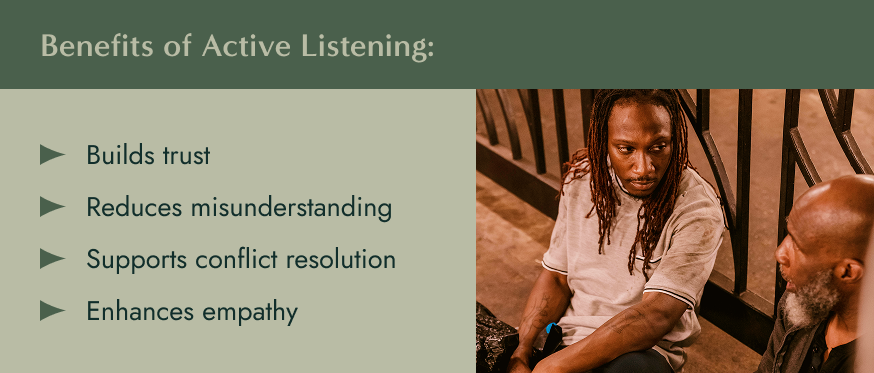
1. Builds Trust and Connection
When active listening is used, people feel heard and valued. This fosters mutual respect and builds stronger relationships, including at home, work, and in social settings.
2. Reduces Misunderstanding
Listening actively helps clarify messages and emotions. This prevents confusion, repeated explanations, and frustration.
3. Supports Conflict Resolution
Listening without judgment or jumping to conclusions can help de-escalate emotions and foster cooperation rather than confrontation. It shifts the conversation from blame to openness.
4. Enhances Collaboration and Empathy
Group work thrives when every participant feels heard. Active listening promotes inclusivity and ensures every voice is heard.
Active Listening Skills
Cultivating your active listening skills means developing specific skills that show you’re listening. This skill is something you need to actively train if you want to use it effectively.

1. Be Present
Turn off distractions (phones, computers, internal thoughts) and turn your body toward the speaker. This may be difficult in some situations, as the need to turn on active listening can happen at a moment's notice, but as soon as you think something important is being said, stop what you’re doing and be present.
2. Notice Nonverbal Cues
Is the person you’re talking with fidgeting? Do they look away when talking about something specific?
Tone of voice and facial expressions carry a lot more meaning than some may think. Study how the speaker is communicating through their body and see if you can notice what they’re saying.
Use what you find from nonverbal cues as a way to inform questions and summaries of what they said.
3. Ask Open-Ended Questions
Open-ended questions help the speaker continue their train of thought and invite thoughtful responses. Don’t ask questions with yes or no questions, but do ask questions like:
- How did that make you feel?
- Why do you think they did that?
- What would have been the ideal outcome?
These questions open up the conversation and encourage the speaker to keep expressing their thoughts and feelings.
4. Reflect and Paraphrase
One way active listening makes people feel heard is through summarizing what the speaker said in your own words.
You can do this by taking in the information you’ve received from verbal and nonverbal cues and repeating that back. Ask the speaker if you’ve gotten it correct and ask for clarification if they don’t think you heard them correctly.
Make sure you clarify that you want to understand what they’re saying. This will let the speaker know that you’re there for them and want to hear them out.
5. Don’t Judge
It’s important not to jump to conclusions about what the speaker is saying. Avoid charged language and keep your thoughts to yourself. It’s important that the speaker is able to talk freely and without fear of being judged.
6. Be Patient
Let silence be. Undisturbed silence gives everyone a chance to reflect, decompress, and think. You should let the silence be before responding to what the speaker has said.
If you’re able to embrace the awkward silence, then people will feel much more likely to open up around you.
Active Listening Activities for Groups
Whether you’re leading a workshop, classroom, or team meeting, group activities can strengthen listening skills together.
1. Pair, Share, and Reflect
Pair up participants. One speaks on a topic while the other listens without interruption, then paraphrases the message to confirm understanding. It’s a simple activity, but it helps people get comfortable with parroting.
2. “Yes, And…” Activity
In this activity, no ideas are negated. Participants go in a circle and build on each other’s points using “yes, and…”. This fosters cooperation and stronger listening.
3. Empathy Mapping
This activity is better for smaller groups. Participants create a visual map of someone else’s thoughts, feelings, and concerns. This helps people understand where deeper concerns come from and broadens perspectives.
Using Active Listening and Mental Health Support
Active listening is a vital tool for helping people through mental health issues. It’s used by professionals, and family members can employ them to offer support for loved ones.

Professional Active Listening
Therapists, doctors, nurses, and counselors all use active listening to get important information from clients and patients while also making them feel at ease.
Professionals are taught how to use active listening during their education and are well-equipped to use it throughout their day.
Related Blogs

Invalidating Feelings: Why It's So Hurtful and How to Avoid Doing It
When you invalidate someone's feelings, they’re less likely to trust you, and they're more likely to present themselves as someone one they’re not.
Everyday Active Listening
Even if you don’t have formal active listening training, you can still use the techniques to be a better support person for someone going through treatment, or everyday struggles.
The next time a loved one starts talking with you:
- Slow down
- Stop other tasks and focus on the speaker
- Observe nonverbal signals
- Reflect and summarize what you heard
- Ask clarifying and open-ended questions
- Respond with empathy, not opinion
Active Listening as a Life Skill
Active listening isn’t just something for a counselor or therapist to practice. It’s an everyday lifestyle skill that can deepen relationships, resolve conflicts, and amplify empathy.
With practice, these skills will become second nature and will start to improve how you connect with others.
If you’re a family member or friend of someone going through the treatment process at Sequoia Behavioral Health, our online resources will help you learn how to be a better support person. It’s not always easy being there for a loved one, but with the right support, knowledge, and resources, you can be a huge help for your friend or family member.
Learn More

Family Therapy
Family therapy can greatly improve a person's success in treatment. During these sessions, the family works together to resolve conflicts and build support.

Group Therapy
In group therapy, individuals can learn, grow together, and experience meaningful support through psychoeducation, recreation, and community development.

Assessments and Diagnostics
Mental health assessments provide insights that are necessary for an accurate diagnosis. Discover how assessments and diagnostics play a role in your treatment plan.
Find Your Loved One Help
Reach out to Sequoia Behavioral Health about finding a way to help your loved one experiencing addiction or other mental health issues.