



Generative AI tools have become a helpful resource for many people. AI chatbots can answer questions, provide information, and offer a space to organize thoughts or explore ideas.
However, these tools also have limitations. Because AI is designed to create natural, conversational responses, it can sometimes provide information that is misleading or reinforce beliefs that are disconnected from reality.
This has raised concerns among mental health professionals about how AI can affect people who are already vulnerable to psychosis or experiencing mental health challenges. In this article, we’ll take a closer look at what AI psychosis means, the signs to look for, and how AI interactions can contribute to concerning experiences for some people.
What Is AI Psychosis?
First, let’s take a look at what psychosis is. Psychosis is a mental health experience that affects how someone understands and interprets reality. During a psychotic episode, a person may experience symptoms such as hallucinations, delusions, or difficulty determining whether certain thoughts or beliefs are accurate.
AI psychosis is an informal term that describes situations where interactions with AI lead to psychotic experiences. It’s not an official mental health diagnosis, but it is a very real experience.
Rather than suggesting that AI directly causes psychosis, researchers are concerned with how AI conversations may reinforce certain beliefs, make inaccurate information seem credible, or become part of an experience where someone has difficulty separating thoughts from reality.
What Are the Signs of AI Psychosis?
While there aren’t official clinical diagnostic criteria for AI psychosis, there are several common signs to look for:
- Believing an AI system has consciousness, special abilities, or hidden intentions
- Feeling that AI-generated messages contain personal meanings meant specifically for you
- Trusting AI responses more than feedback from trusted people in your life
- Becoming increasingly isolated from real-world relationships
- Having difficulty separating AI-generated information from reality
- Feeling distressed, fearful, or overwhelmed because of AI interactions
Not everyone who has frequent interactions with AI will experience AI psychosis. It’s most common in people who are already prone to psychosis or similar mental health struggles.
With that being said, AI interactions can become problematic for anyone if they affect someone’s ability to evaluate information, maintain relationships, or function in daily life.
Professional Mental Health Support in Mesa, AZ
At Sequoia Behavioral Health, we help those struggling with anxiety, depression, trauma, and more by providing a personalized therapy program. Contact us today to begin your mental health journey towards a more grounded body and mind.

Why Do People Experience AI Psychosis?
AI psychosis is a recent phenomenon, and clinical research is still being conducted to fully understand how AI can affect the way people think, feel, and interpret information.
However, many researchers have found that the basic mechanisms of generative AI can increase the risk of psychosis, especially in vulnerable individuals.
In an article published by the National Institutes of Health, researchers examined five ways that generative AI can contribute to psychosis.
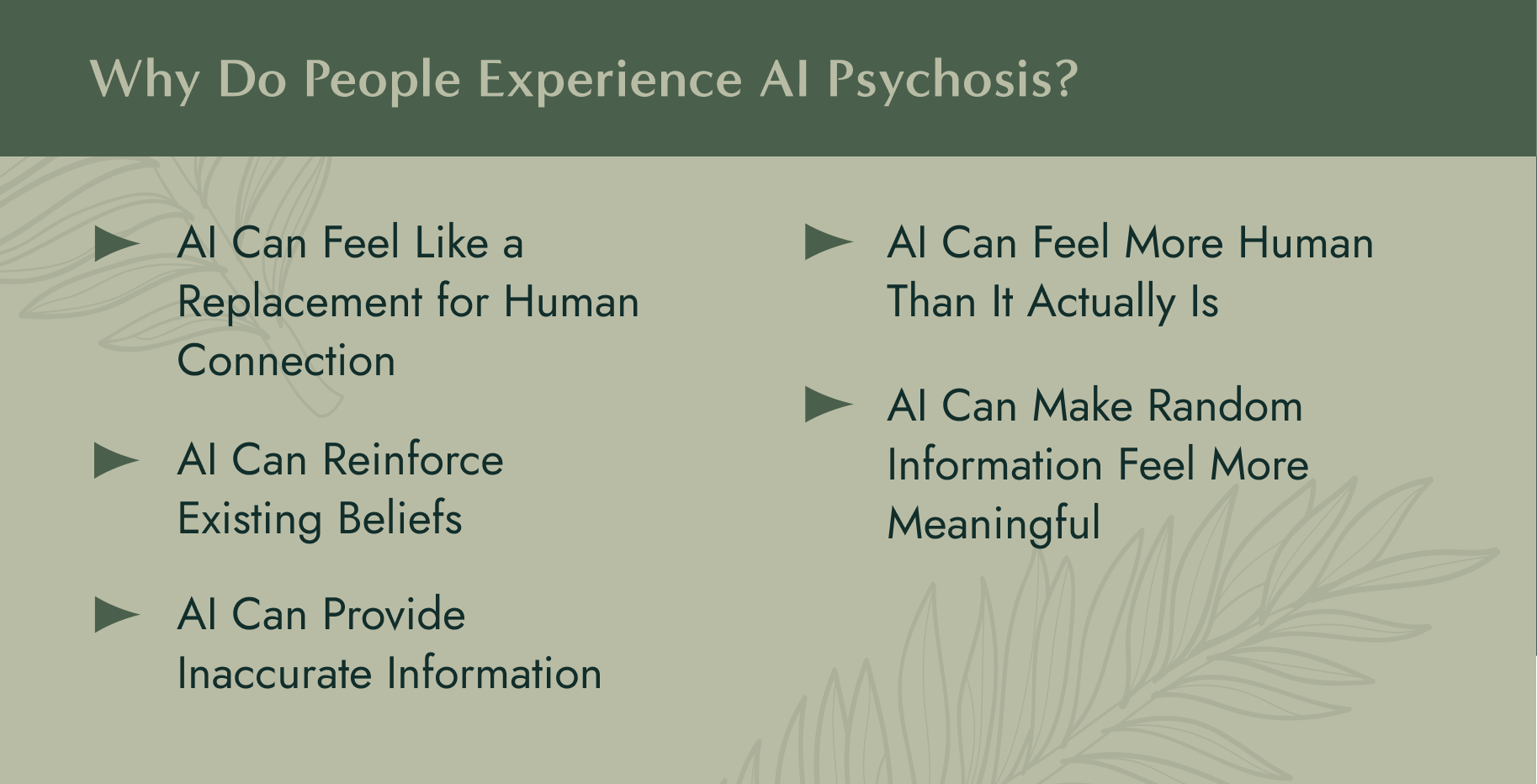
1. AI Can Feel Like a Replacement for Human Connection
Generative AI chatbots are designed to provide immediate, ongoing conversations. For people who already feel isolated or disconnected from others, these interactions can feel like a source of companionship and understanding.
While AI can provide support in certain situations, it cannot replace the perspective and emotional connection that come from real relationships. Spending more time interacting with AI while withdrawing from human connection can reduce opportunities to receive feedback that helps someone evaluate their thoughts and experiences.
2. AI Can Reinforce Existing Beliefs
AI chatbots often respond in ways that are conversational and supportive. While this can make interactions feel more engaging, it can also create issues if someone is already struggling with beliefs that are disconnected from reality.
Instead of questioning a belief or offering a different perspective, an AI response can reinforce the way someone is already thinking. For someone experiencing paranoia, delusional thoughts, or difficulty evaluating information, these responses can feel like confirmation that their beliefs are accurate.
3. AI Can Provide Information That Sounds Accurate but Isn’t Always True
AI systems can generate responses that sound confident and believable, even when the information is incorrect. This is commonly referred to as an AI “hallucination.”
For most people, these mistakes are easy to identify and correct. For someone who is already struggling to separate thoughts, interpretations, and reality, it’s easy to mistake AI hallucinations as evidence that supports their beliefs.
4. AI Can Feel More Human Than It Actually Is
Modern AI tools can communicate in ways that feel surprisingly personal. They can remember details from conversations, respond in an empathetic way, and create realistic text, images, or voices.
These features make it easier for people to view AI as having human qualities, intentions, or awareness that it doesn’t actually possess. AI does not have thoughts, feelings, or consciousness. Instead, it analyzes patterns in information to generate responses.
When someone begins viewing AI as an all-knowing source of truth or guidance, it can become harder to maintain a clear understanding of what AI is and what it can actually do.
5. AI Can Make Random Information Feel More Meaningful
The human brain naturally looks for patterns and connections, especially during periods of stress or uncertainty. For people who are vulnerable to psychosis, this tendency can become stronger and cause unrelated information to feel personally significant.
When AI provides personalized responses, it can make certain ideas feel more meaningful or connected than they actually are. Without outside perspectives or reality-based feedback, these interpretations may become harder to question.
Related Blogs

What Does it Mean to be Grounded?
Being grounded is a result of mindfulness and emotional regulation and stability. Learn what it means and how to get there.

How to Stop Dissociating
Dissociating disconnects us from ourselves and the world around us. Discover what dissociation feels like and how to stop it when it occurs.

Find Freedom From Phone Addiction: Ending the Doomscroll
Half of Americans identify themselves as being addicted to their phone. Learn what causes it and how to break free.
Finding Professional Support for Mental Health Concerns
AI can be a helpful tool, but it also has limitations. If you notice changes in your thoughts, emotions, relationships, or daily life, it may be time to seek support from a mental health professional.
Whether your concerns are related to AI or other areas of your life, therapy can help you better understand your experiences and find healthier ways to address your mental health concerns.
At Sequoia Behavioral Health, we help people understand the root causes of their mental health challenges and develop personalized treatment plans that support lasting healing.
Reach out to our team to learn how we can help you find support and move forward.
Learn More

Psychoeducation
Psychoeducation enables people to understand themselves better and discover practices to improve their behavioral and mental health.

Mindfulness-Based Cognitive Therapy
Mindfulness-Based Cognitive Therapy mixes CBT with mindfulness practices to help clients become more aware of their emotions, thoughts, and behaviors.

Dialectical Behavioral Therapy
Dialectical Behavioral Therapy is a therapy focused on teaching important skills like mindfulness, acceptance, regulation, and interpersonal effectiveness.
Sequoia Behavioral Health provides holistic healing for people experiencing addiction or recovering from a mental health crisis. Reach out to learn if Sequoia Behavioral Health is the right fit for you.