



Anxious thoughts can feel incredibly convincing. In the moment, it may seem like the worst-case scenario is certain to happen, even when there isn't much evidence to support it. The more you think about those worries, the more real they can become.
The good news is that you don't have to believe every anxious thought that comes to mind. With practice, you can learn to challenge unhelpful thinking patterns and respond to them in a healthier way.
In this article, we'll take a look at why anxious thoughts happen, why they feel so real, and how you can begin challenging anxious thoughts using a simple five-step process.
What Are Anxious Thoughts?
Anxious thoughts are patterns of thinking that overestimate danger or underestimate your ability to cope.
Some common examples of anxious thoughts include:
- Catastrophizing: Expecting the worst possible outcome.
- Jumping to conclusions: Assuming something negative will happen without enough evidence.
- Overgeneralization: Believing one difficult experience means the same thing will always happen.
- Emotional reasoning: Assuming something must be true because it feels true.
- Mind reading: Assuming you know what other people are thinking or how they feel about you.
- Discounting the positive: Ignoring positive experiences or evidence that challenges your fears.
Mental health professionals often refer to these patterns as cognitive distortions, which are unhelpful ways of interpreting situations rather than accurate reflections of reality.
Why Do Anxious Thoughts Feel So Real?
Anxiety is designed to protect you from danger. When your brain senses a possible threat, it becomes more alert and starts looking for ways to keep you safe.
The problem is that anxiety can't always tell the difference between a real danger and an imagined one. As a result, your brain may treat uncertain situations as though they're guaranteed to end badly. This is why anxious thoughts often feel so believable, even when there's little evidence that something is wrong.
Learning to challenge anxious thoughts can interrupt this cycle. Instead of accepting every worry as fact, you can begin looking at your thoughts from a more balanced perspective.
What Does It Mean to Challenge Anxious Thoughts?
Challenging an anxious thought doesn't mean pretending everything is fine or forcing yourself to think positively. It's about slowing down long enough to examine whether your thoughts accurately reflect what's happening.
Over time, this practice can help you recognize unhelpful thinking patterns and replace them with thoughts that are more realistic and compassionate.
Professional Support for Anxiety in Mesa, AZ
At Sequoia Behavioral Health, we create treatment plans that address both your symptoms and the underlying causes of anxiety. Reach out today to begin your path to relief.

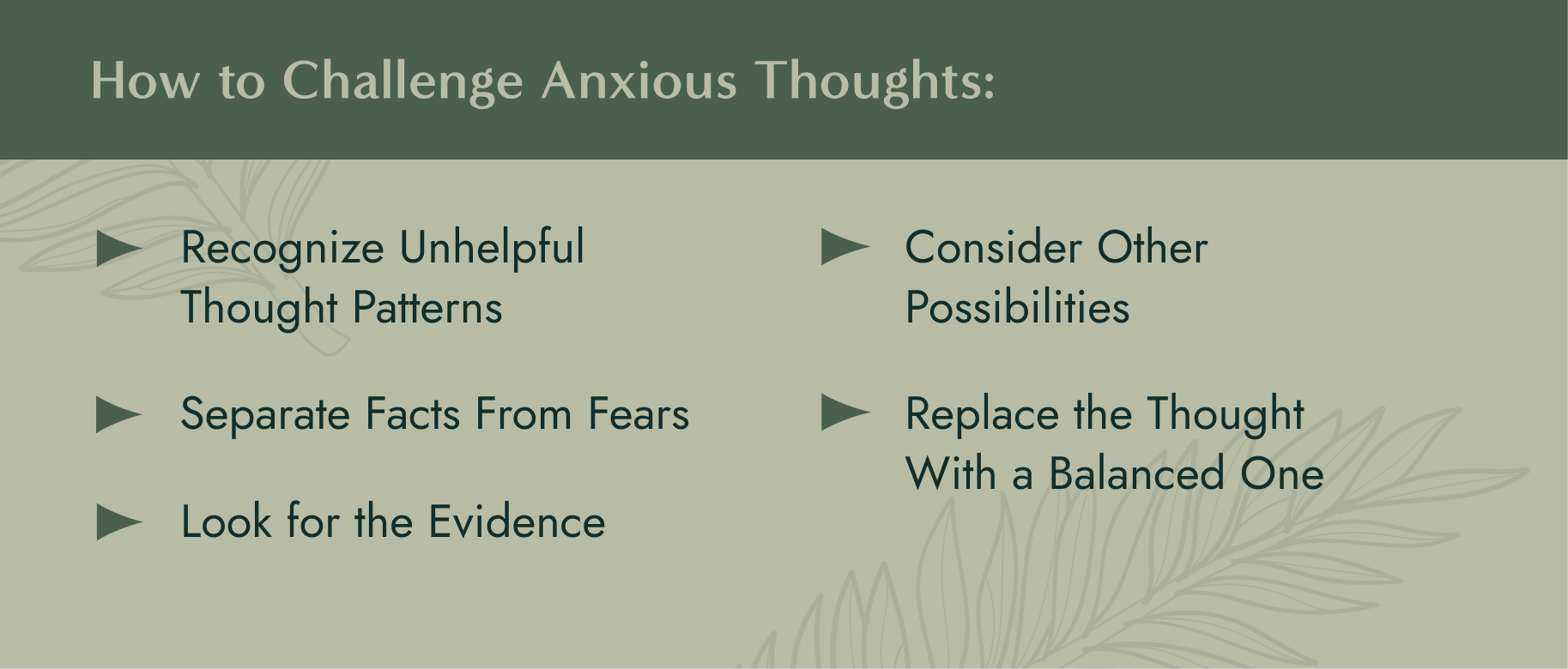
How to Challenge Anxious Thoughts in 5 Steps
One of the most effective ways to challenge anxious thoughts comes from cognitive behavioral therapy (CBT). At the heart of CBT is a technique called cognitive restructuring, which helps people recognize unhelpful thought patterns and respond to them differently.
The next time anxiety starts to take over, try working through these five steps.
1. Recognize Unhelpful Thought Patterns
The first step in challenging anxious thoughts is learning to recognize when anxiety is influencing the way you think. This isn't always easy because anxious thoughts often happen automatically. The more familiar you become with common thinking patterns, the easier they are to identify in the moment.
Some examples of unhelpful thought patterns include:
- Expecting the worst possible outcome before anything has happened
- Focusing only on what's going wrong while overlooking what's going well
- Viewing situations as complete successes or complete failures, with no middle ground
- Assuming you're responsible for things that are outside your control
Simply recognizing these patterns doesn't make them disappear, but it can help you pause before accepting them as facts. This awareness creates the foundation for changing the way you respond to anxious thoughts.
2. Separate Facts From Fears
Once you've recognized an anxious thought, resist the urge to immediately accept it as the truth. Anxiety often presents possibilities as certainties, which can make a feared outcome feel much more likely than it actually is.
Instead, take a step back and remind yourself that thoughts are interpretations of a situation, not proof of what will happen. Ask yourself whether you're responding to the facts in front of you or to a fear about what might happen.
3. Look for the Evidence
After creating some distance from the thought, take a closer look at the information behind it. Anxiety usually focuses on details that support your fears while overlooking evidence that suggests a different outcome.
Ask yourself:
- How likely is the outcome I'm worried about?
- What evidence supports this thought?
- What evidence challenges it?
- Have I experienced something similar before, and what actually happened?
Looking at the evidence can help you recognize when anxiety is making assumptions instead of reflecting reality. Once you've examined the thought more closely, the next step is to consider whether there are other ways to view the situation.
4. Consider Other Possibilities
Anxiety narrows your focus and can make the worst-case scenario feel like the only possible outcome. This step is about expanding your perspective and considering other explanations that may fit the situation.
Ask yourself:
- What are some other possible explanations?
- Is there another way to interpret this situation?
- What would I say to a friend who had this thought?
Considering other possibilities doesn't mean ignoring your concerns or assuming everything will turn out perfectly. Instead, it allows you to see the full picture instead of viewing the situation only through the lens of anxiety.
5. Replace the Thought With a Balanced One
After working through the previous steps, you can start to create a more balanced way of looking at the situation. A balanced thought takes the facts into account while leaving room for uncertainty.
The goal isn't to force yourself to think positively or convince yourself that nothing will go wrong. It's about replacing an automatic anxious response with a thought that is more realistic, compassionate, and helpful.
For example:
- Anxious thought: "Everything is going to go wrong."
- Balanced thought: "I don't know exactly what will happen, but I've handled difficult situations before."
A balanced thought reminds you that uncertainty doesn't automatically mean something bad will happen. When anxiety starts to take over, focus on what you can control in the present instead of trying to predict every possible outcome in the future.
Related Blogs

Anxiety About the Future
Learn why anxiety about the future happens, what can contribute to it, and how you can begin managing anxious thoughts in healthier ways.
.jpg)
Anxiety Relief: Techniques and Tools You Can Use Now
Anxiety relief is a short-term and long-term effort. Learn how to start managing your anxiety here.

"But You Seem Fine" — The Invisible Battle of High-Functioning Anxiety
Those with high-functioning anxiety look like hard-workers on the outside, but they're driven by intense feelings of anxiety.
When to Seek Professional Support for Anxiety
If anxious thoughts begin interfering with your relationships, work, school, sleep, or daily life, it may be time to reach out to a mental health professional.
Therapy can help you identify unhelpful thought patterns, understand where your anxiety is coming from, and teach you how to respond to anxious thoughts in a healthy, more productive way.
Evidence-based approaches such as cognitive behavioral therapy (CBT) and acceptance and commitment therapy (ACT) can be especially helpful for anxiety. CBT focuses on recognizing and changing unhelpful thought patterns, while ACT helps people learn how to accept difficult thoughts and emotions without allowing them to control their actions.
Professional Support for Anxiety in Mesa, AZ
At Sequoia Behavioral Health, we help people understand the root causes of anxiety and develop healthier ways to cope with difficult thoughts and emotions. Our team works closely with each client to create a treatment program that supports their unique experiences and goals.
Reach out to a mental health professional here at Sequoia to learn how our team can help you better understand your anxiety and find a path forward.
Learn More

Cognitive Behavioral Therapy
Thoughts control behaviors more than you might think. Cognitive Behavioral Therapy connects emotions and behaviors to help manage negative behaviors.

Acceptance and Commitment Therapy (ACT)
Acceptance and commitment therapy is an action-oriented therapy that allows clients to move past negative emotions and thoughts, rather than fighting them.

Mindfulness-Based Cognitive Therapy
Mindfulness-Based Cognitive Therapy mixes CBT with mindfulness practices to help clients become more aware of their emotions, thoughts, and behaviors.
Your journey at Sequoia starts with a simple admissions process where we learn more about you, your concerns, and your goals. Learn more about what to expect on your path to mental wellness.