
Psychodynamic Therapy at Sequoia
Explore our Psychodynamic Therapy program and learn how personalized care can support your mental health and healing.
Do you ever wonder why you are the way you are? There might be ways you behave that you want to change, but you’re not even sure why you even do those things. Maybe you don’t understand why you react in certain situations.
Human behavior is a complex thing. We don’t always act the way we want, and most of the time, we don’t even know why we did what we did. Psychodynamic therapy helps us answer these questions and understand why we think, feel, and act the way we do.
There are unconscious patterns that influence our behaviors, and our adult personality is heavily molded by our childhood experiences. Psychodynamic therapy helps us find the root of who we are.
Roots in Psychoanalytic Theory
So many of our daily thoughts happen unconsciously. Whether we like it or not, our unconscious motives and thoughts influence our current thoughts and feelings.
Psychodynamic therapy is based on the theory sharing the same name, which is based on psychoanalytic theory. Created by Sigmund Freud, it’s meant to bring unconscious thoughts into the consciousness. Only when these thoughts have surfaced, can they be analyzed.
Freud thought unconscious thoughts are typically repressed thoughts, feelings, and emotions from childhood. This approach takes a long time, and treatment is very intensive. Treatment typically lasts multiple years with 3 to 4 sessions every week.
Psychodynamic Theory
Psychodynamic theory was later developed by Freud and his students. Instead of focusing exclusively on thoughts, this theory seeks to find how childhood experiences affect behavior.
This theory asserts that all behavior has a cause. The cause of that behavior is determined by childhood experiences. It also made treatments short-term. The typical patient will have a weekly session and the treatment takes less than 20 weeks.
The Iceberg Theory
The iceberg theory is instrumental in understanding how psychodynamic therapy works. It’s easiest to think of this as a picture. All of us are like an iceberg. The part that sticks out of the water is how we present ourselves. But under the water, there is a large unseen portion of us that influences what is visible. Freud believed that there are parts of our personality:
- Id—Our unconscious inherited instincts
- Ego—Our decision maker that mediates between the real world and the id
- Superego—Our learned values
These three aspects of our personality need to be in balance for us to properly function in society.
The id occupies our unconscious world while the ego and superego occupy our conscious and unconscious world. Our ego acts as the filter for both the id and the superego.

The Unconscious
Even though humans are a complex species, we still have basic instincts that interact with us daily. The unconscious thoughts of our id sometimes go unrecognized. Even though they occupy the bottom of the iceberg, they are the most important and defining part of the mind.
The instincts that exist within the id are selfish and motivated by survival. A good picture that explains what the id is can be found in a lot of media—it’s often depicted as a little devil on someone’s shoulder, encouraging them to do something selfish.
The Preconscious
The preconscious houses all of our stored knowledge. Obviously, we don’t need all that information all the time, but we can freely call upon it when it’s important. It’s thoughts we have, but are not fully in tune with all the time.
These thoughts were not considered repressed by Sigmund Freud. If they were, we wouldn’t be able to recall them.
The Conscious
This is the tip of the iceberg. It is the thoughts, cognitions, and perceptions we notice. We might think this area is the most important part of us, but in reality, the deeper parts of the iceberg have a bigger part to play in shaping who we are.
The psychodynamic perspective states that our self-awareness comes from our deeper unconscious thoughts—not the other way around.

How Psychodynamic Therapy Works
Psychodynamic therapy looks similar to other forms of talk therapy. A therapist will sit down with a client and talk through their thoughts, feelings, and emotions. The biggest difference between this type of therapy and other forms of psychoanalytic theory is that it focuses more on behavior than thoughts alone.
…our unconscious motives and thoughts influence our current thoughts and feelings.
Identify Behavior Patterns
Psychodynamic treatment will start by addressing behavior patterns. Although it might seem redundant or boring, talking about how you behave is an important part of getting to the bottom of your iceberg.
Once you’ve looked at your behaviors, you’ll hopefully notice some trends. As you talk with your therapist, the goal is to find out what you’re responding to and why. Think of it as going deeper down an iceberg. You may be surprised by how deep it goes.
Understand Emotions
A second area your psychodynamic therapist will want to guide you through is your emotions. Emotions can guide your behavior. So, while you’re examining the iceberg of your consciousness, you might as well also look for remnants of other repressed feelings or thoughts.
Sometimes our feelings are connected to a deeper part of who we are. This kind of therapy helps us understand exactly what it is we’re feeling and what triggered it.
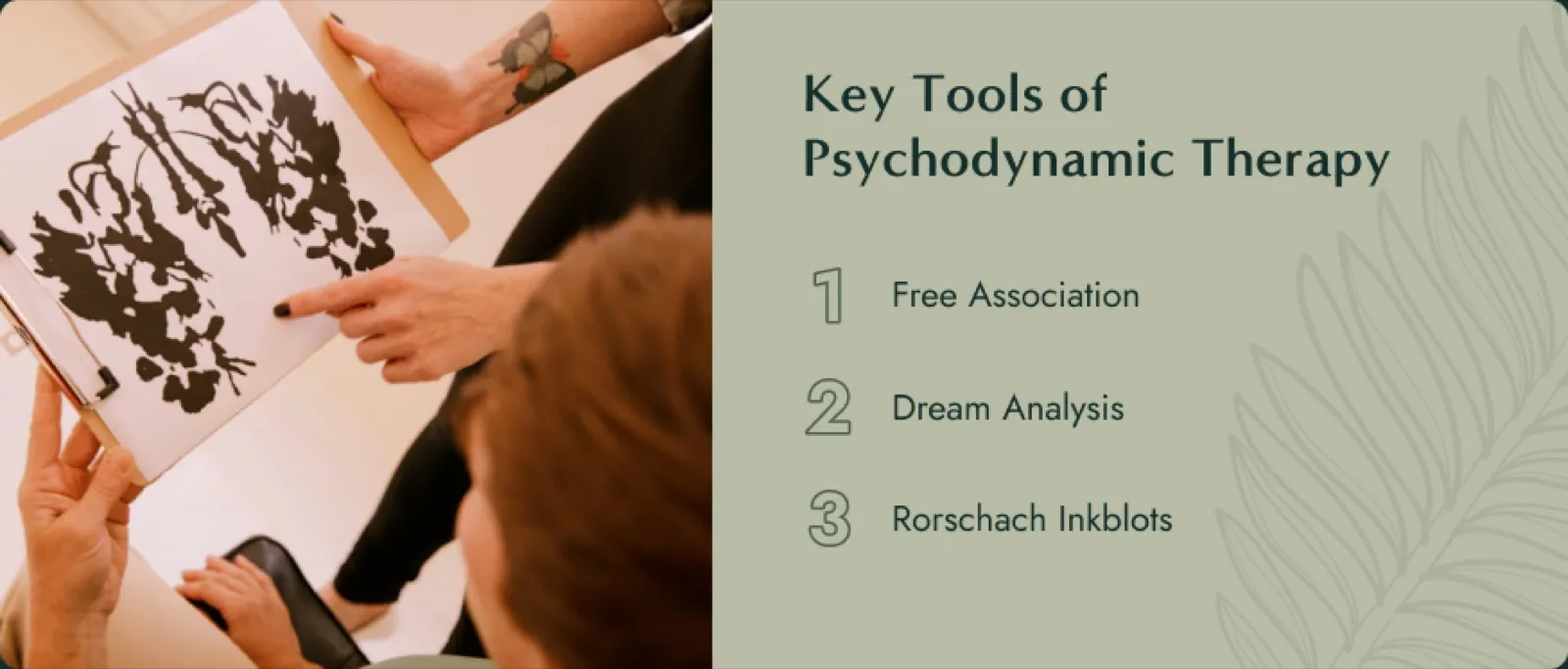
Key Tools of Psychodynamic Therapy
Exploring our unconscious thoughts is not an easy task. These thoughts are buried deep within our psyche. If they’re repressed, our brain might do whatever it takes to make sure you don’t notice them.
Luckily, there are tools therapists use to gain insight into this area of our thoughts.
Free Association
Free association is a helpful tool therapists can use to help find unconscious ways of thinking. It’s a simple technique that is considered one of the most important tools in a therapist’s toolbox. It’s so simple that some people use it as a game.
Free association works by the therapist saying a word and the client saying the first thing that comes to mind. This requires the patient to be open and honest about what it is they’re thinking. Their responses have to be their unfiltered initial thoughts.
Free association can also refer to when the client jumps between subjects as the connection occurs to them. These discussions are required to be driven by the client’s thoughts.
This tool can sometimes provoke intense reactions. Although these reactions might be scary, they are important for understanding your unconscious self more. You and your therapist should work to build a safe space before digging too deep into any repressed thoughts.
Psychodynamic therapy lets patients go into their past so they can shape their future.
Dream Analysis
Dreams can be weird, mundane, and strangely telling. Dreams are closely associated with our unconsciousness. It’s true that when we fall asleep a part of our inner selves slips out.
There are different theories about what the meaning of dreams are. Some propose that dreams have universal meanings. Others propose that dreams have unique meanings that are specific to the individual.
Whatever the approach is to dream analysis, your therapist might want you to take note of your dreams and talk with you about what they could mean about who you are.
Rorschach Inkblots
Rorschach tests are similar to free association, but instead of words, they’re abstract pictures. Therapists will show an inkblot and the client will share what it makes them think of. Afterward, the two of them will talk about their answer until they find the “why” of their answer.
These help dig deeper into areas of the unconscious. Areas that aren’t often associated with words.
When Psychodynamic Therapy is Useful
Psychodynamic therapy is a useful treatment for several mental health conditions:
- Depression
- Anxiety disorders
- Anorexia nervosa
- Borderline personality disorder
- Addiction
Psychodynamic psychotherapy is helpful for these conditions because our mental health is often influenced by our childhood experiences and repressed memories. ****
Discover Your Unconscious Mind
In all of our treatment plans, we aim to get to the root of what ails you. We take this approach because we believe taking a holistic approach gives people the best chance of fully recovering. We treat the whole person—even the unconscious parts.
Psychodynamic therapy lets patients go into their past so they can shape their future. Sequoia Behavioral Health offers patients the ability to get personalized treatments that are conducted in a safe space. If you or a loved one are living life with a mental health condition that is making life difficult, contact us and start your journey.
Schedule a Call
Thanks — we will be in touch.
That did not send. Please try again.