Free Workbook & Guide
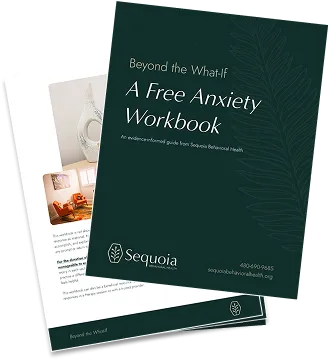
Beyond the What-If: A Free Anxiety Workbook
A free, evidence-informed guide to meeting uncertainty with greater clarity, courage, and choice.

Inside the Guide
Inside this guide, you'll explore.
Anxiety has a way of turning possibility into urgency. It asks us to predict what will happen, prevent every mistake, and find certainty before we take the next step. These efforts often begin as understandable attempts to feel safer. Yet over time, life can become organized around avoiding uncertainty.
Beyond the What-If is a brief, practical workbook grounded in cognitive behavioral therapy (CBT) and acceptance and commitment therapy (ACT) principles. Through guided reflection and gentle behavioral experiments, you will explore the patterns that may be maintaining anxiety, respond more flexibly to anxious thoughts, and make choices based on what matters to you.
The aim of this guide is not to eliminate every anxious feeling or push yourself beyond what feels manageable. It is to build greater trust in your ability to meet anxiety with compassion, curiosity, and discernment.
- How thoughts, feelings, and behaviors form an anxiety cycle
- How to tell a problem you can act on from a hypothetical “what if”
- How avoidance and reassurance can bring short-term relief while strengthening anxiety
- How to test anxious predictions with curiosity rather than certainty
- How to make room for discomfort without treating it as a command
- How values can guide your next step when certainty is unavailable
Beyond the What-If
You do not have to wait for certainty to begin living.
Anxiety may promise that one more answer, one more check, or one more delay will finally make you feel ready. This workbook offers another path: learning what deserves your attention, what can be allowed to remain uncertain, and what small act of courage is available now.
Download the complimentary guide and begin changing your relationship with worry (one thoughtful experiment at a time).

Your Next Step
Unlock the full resource guide.
By submitting this form, you agree to receive the requested guide and occasional mental health resources from Sequoia Behavioral Health. You may unsubscribe at any time.
Thank you. The full guide is below.
That did not send. Please try again.
Educational-use notice: This complimentary workbook provides general educational information and self-reflection exercises. It is not medical or mental health advice, diagnosis, treatment, or crisis care; it is not a substitute for individualized care from a qualified professional; and downloading or using it does not establish a clinician–patient relationship with Sequoia Behavioral Health.
If you are in the United States and need immediate emotional support, call or text 988. If you or someone else is in immediate danger or needs urgent medical attention, call 911.
FAQ
Questions about finding support.
Explore common questions about Sequoia’s programs, insurance, and getting started.
How do you challenge anxious thoughts?
In Sequoia’s Beyond the What-If workbook, start by putting the worry into words. Ask what evidence supports your prediction and what points to another possibility. A balanced response can leave room for uncertainty without treating the worst outcome as a certainty.
What are the steps in challenging thoughts for anxiety?
A common CBT approach has four steps: identify the anxious thought, examine the evidence, consider alternative explanations, and create a more balanced response. Then test it with a small behavioral experiment.
When is the best time for worry time?
Pick a consistent 15 to 20 minutes, ideally earlier in the day and not right before bed. When worries come up at other times, jot them down and save them for worry time. This builds a sense of control over anxious thinking.
How do you journal for anxiety?
Write down what you're worried about, what you predict will happen and how strongly you believe it. Later, look back at what actually happened. Over time, patterns show up that make anxious predictions easier to question.
What is ACT for anxiety?
Acceptance and commitment therapy (ACT) helps you make room for anxious thoughts and feelings instead of fighting them, while taking action toward what matters to you. It's one of the two approaches the workbook is built on.
Ready to Start Your Healing Journey?
You do not have to know exactly what you need before reaching out. Our admissions team can help you understand the next step.